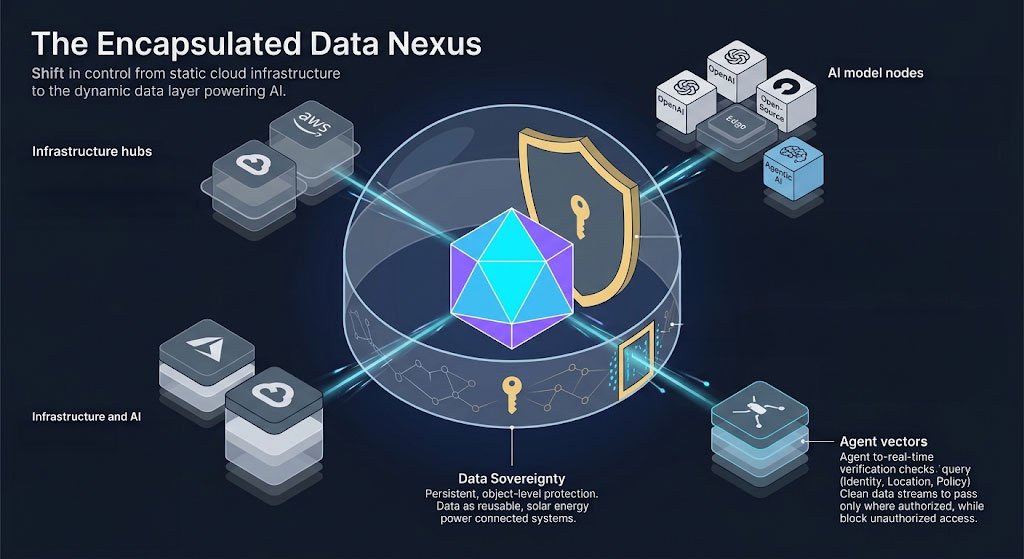
The podcast’s central argument aligns closely with XQ’s view of the next phase of cybersecurity: the strategic question is no longer simply where AI runs, but who controls the data AI is allowed to use. (Apple Podcasts)
A recent episode of AI Governance, Strategy & the Future of Intelligent Organizations makes a compelling argument: as artificial intelligence becomes embedded in enterprise operations, data sovereignty may matter more than access to the most powerful AI model.
That idea deserves much more attention.
The conversation is ultimately about a fundamental shift in how organizations should think about AI. The competitive advantage is not simply the model. It is the proprietary data, knowledge, operational information, intellectual property, customer information, and institutional knowledge that AI uses to produce value.
And if that data is the strategic asset, organizations need to control it wherever it goes.
Listen to Episode 38: “Why Data Sovereignty Matters More Than the Best AI Model”
The podcast’s central message
Episode 38 argues that organizations are increasingly recognizing data sovereignty as a strategic priority. It uses an interesting evolution of the familiar phrase “data is the new oil.”
The podcast proposes that, in the AI economy, data is better understood as the new solar energy.
Oil is consumed. Data can continue generating value.
Enterprise data can be analyzed, reused, combined with other information, fed into AI systems, used to train organizational knowledge systems, and transformed into decisions and automation. Its value can compound over time.
That creates a new strategic problem.
The more valuable data becomes, the more important it becomes to answer:
- Who owns the data?
- Where is it stored?
- Who can access it?
- Where can it be processed?
- Where are the encryption keys?
- Can a cloud provider access it?
- Can another jurisdiction compel access?
- Can the data move across borders?
- Can an AI system retrieve it?
- What happens when an employee, application, AI agent, or third party is compromised?
- Can access be revoked after the data has already been distributed?
The podcast also highlights what it calls the “uncertainty accelerator”: AI is evolving so quickly that organizations cannot build governance strategies around today’s models and assume those controls will remain adequate.
Traditional compliance frameworks remain important, but they are not sufficient by themselves.
The challenge is moving from policy statements to technical enforcement.
Data residency is not the same as data sovereignty
This distinction is critical.
Putting data in a particular country or cloud region does not necessarily mean that the organization has sovereign control over that data.
Data residency answers:
Where is the data stored?
Data sovereignty asks a much harder question:
Who has the technical ability and legal authority to access the data?
Those are different problems.
A company can store information in a European cloud region, for example, while still relying on infrastructure, administrators, applications, identities, or encryption systems that exist outside the jurisdiction.
Simply changing the location of the server does not necessarily change who ultimately controls the data.
This is where XQ approaches the problem differently.
XQ: Make sovereignty a property of the data
XQ’s approach is to move the sovereignty control point from the infrastructure layer to the data layer.
Rather than saying:
“Our data is sovereign because it is inside this cloud.”
XQ’s model is:
“Our data remains sovereign because nobody can access or decrypt it unless the data owner’s policy allows it.”
XQ wraps persistent cryptographic protection and policy enforcement around the data itself.
The data can therefore move between cloud storage, applications, databases, SaaS platforms, edge environments, AI systems, and other infrastructure while the protection travels with it.
This is the fundamental concept behind Zero Trust Data.
XQ describes this as a cryptographic trust boundary around the data rather than relying exclusively on a physical or network perimeter. (XQ Message)
The cloud does not have to be sovereign for the data to be sovereign
This distinction becomes particularly important as organizations increasingly depend on hyperscalers.
Organizations do not necessarily want to abandon AWS, Azure, Google Cloud, SaaS applications, or global infrastructure.
They want the benefits of those platforms without surrendering control of their most sensitive data.
XQ’s architecture is designed around that principle.
Data can be encrypted before it enters a cloud environment, while encryption keys and policy enforcement remain under the customer’s control. XQ’s sovereign-data architecture supports customer-exclusive key control, jurisdictional restrictions, and policy enforcement at the data-object level. (XQ Message)
That changes the sovereignty equation.
The question is no longer:
“Which sovereign cloud should we use?”
It becomes:
“How do we make our data sovereign regardless of the infrastructure on which it operates?”
Sovereignty that travels with the data
Consider an AI application operating across multiple countries.
A conventional architecture might rely on:
- A regional cloud.
- Network segmentation.
- Identity controls.
- Cloud access policies.
- Data residency configurations.
- Compliance documentation.
Those controls are valuable, but they largely depend on the infrastructure remaining inside the approved boundary.
XQ adds another layer:
the data itself remains cryptographically protected and policy-controlled.
For example, a policy could require:
Only users in the European Union, with an approved identity and appropriate authorization, may decrypt this dataset.
If an unauthorized user attempts to access the information, the system does not simply record that the access violated policy.
The data remains encrypted.
That is an important distinction between governance and enforcement.
From “trust the environment” to “verify every data access”
This is also where XQ’s approach fits naturally with Zero Trust.
Traditional security frequently establishes a trusted environment and then controls access to that environment.
Zero Trust assumes that trust must be continuously evaluated.
XQ extends that principle directly to the data.
Access decisions can incorporate factors such as:
- Identity
- Role
- Attributes
- Location
- Jurisdiction
- Environment
- Mission or business context
- Data classification
- Policy
The result is a model where being inside the network is not sufficient to access the data.
And being the administrator of the infrastructure does not automatically mean having access to the plaintext.
XQ’s platform uses persistent encryption, RBAC/ABAC and policy-driven access controls to enforce those decisions at the data layer. (XQ Message)
This becomes even more important with AI agents
The podcast’s argument becomes particularly powerful when applied to the next generation of AI.
The enterprise is moving from:
AI that answers questions
to:
AI that retrieves information, calls APIs, accesses databases, executes workflows, and takes actions.
An AI agent with access to enterprise information can potentially become one of the most powerful users inside an organization.
That creates a new security question:
Should an AI agent be trusted simply because the human who initiated it is trusted?
XQ’s answer is no.
The data itself should remain governed.
An AI agent should have to satisfy the same fundamental requirements as any other data consumer:
Who are you?
What are you allowed to access?
What data are you requesting?
Where are you operating?
What is the policy for that data?
Can this data be used for this purpose?
This creates an important foundation for AI Data Loss Prevention and sovereign AI.
The AI model does not have to be trusted with unrestricted access to the organization’s information.
Instead, the organization’s data policies determine what the AI can actually retrieve and use.
The AI model becomes interchangeable. The data control layer does not.
This leads to perhaps the most important strategic implication of the podcast.
AI models are changing rapidly.
Today’s leading model may be replaced by another model tomorrow.
Organizations will increasingly use multiple models simultaneously:
- Commercial models
- Open-source models
- Private models
- Sovereign models
- On-premise models
- Edge models
- Specialized models
- Agentic AI systems
The data, however, remains the organization’s strategic asset.
That means organizations should avoid building their security architecture around the assumption that one particular AI model or cloud provider will remain dominant.
Instead, they need a data control plane that sits above the changing AI infrastructure.
That is the role XQ is designed to play.
From data governance to data enforcement
There is another important connection between the podcast and XQ.
Many organizations already have sophisticated governance tools.
They can discover data.
They can classify it.
They can apply labels.
They can identify sensitive information.
They can create policies.
The problem is what happens next.
Can those policies actually prevent unauthorized access to the data?
XQ’s model connects the governance decision to cryptographic enforcement.
A simplified lifecycle looks like this:
Discover → Classify → Label → Encrypt → Apply Policy → Enforce → Monitor → Audit → Revoke
That means sovereignty does not remain a policy document.
It becomes an operational control.
The organization can establish rules about who may access particular information, where that information may be accessed, and under what conditions it may be decrypted.
Sovereignty without giving up the cloud
This is perhaps the most practical takeaway.
Organizations should not have to choose between:
Cloud innovation
and
Data sovereignty.
They should be able to have both.
XQ’s approach is to separate the data control plane from the infrastructure control plane.
AWS, Azure, Google Cloud, SaaS providers, data platforms and AI platforms can continue providing compute and storage.
XQ provides an additional layer of cryptographic data protection and policy enforcement.
This allows an organization to maintain cloud flexibility while retaining control over its most sensitive information. XQ describes both cloud-only and hybrid/on-premises deployment models for sovereign data governance. (XQ Message)
The emerging architecture: sovereign data + intelligent infrastructure
The podcast correctly identifies a major transition in enterprise technology.
The question is no longer simply:
“Where should we run AI?”
It is becoming:
“How do we safely give AI access to our most valuable information without giving up control of that information?”
That requires a new architecture.
AI provides the intelligence.
Cloud provides the infrastructure.
Identity establishes who or what is requesting access.
Governance establishes what should be allowed.
But cryptography and policy enforcement determine what can actually happen.
That is the role of Zero Trust Data.
The future is not sovereign infrastructure alone
Sovereign infrastructure will remain important for governments, defense organizations, regulated industries and critical infrastructure.
But infrastructure sovereignty alone cannot solve the problem.
Data moves.
Applications move.
AI models move.
Workloads move.
Organizations collaborate across borders.
Agents retrieve information from multiple systems.
Cloud environments change.
The sovereignty control therefore needs to move with the data.
That is the fundamental idea behind XQ’s approach to data sovereignty.
Instead of making the data dependent on a particular cloud, network, facility or application, XQ makes the protection persistent at the data layer.
The result is a model in which organizations can continue to adopt new AI technologies and cloud infrastructure while maintaining control over their most valuable asset.
The future of AI may be determined by who has the best model.
But the future of enterprise AI will increasingly be determined by who controls the data the models are allowed to use.
And that is why data sovereignty is becoming an AI strategy—not simply a compliance strategy.
XQ Message — Sovereign Data Governance
Frequently asked questions
What is the difference between data residency and data sovereignty?
Data residency describes where data is stored, while data sovereignty asks who has the technical ability and legal authority to access it. A company can keep information in a European cloud region yet still rely on administrators, identities, applications or encryption systems outside that jurisdiction. Changing a server's location does not by itself change who ultimately controls the data, which is why XQ treats sovereignty as a separate, harder problem.
How does XQ make data sovereign without leaving AWS, Azure or Google Cloud?
XQ moves the sovereignty control point from the infrastructure layer to the data layer, so the cloud does not have to be sovereign for the data to be. Data can be encrypted before it enters a cloud environment while encryption keys and policy enforcement stay under the customer's control. Hyperscalers keep providing compute and storage, and XQ adds persistent cryptographic protection with customer-exclusive key control and jurisdictional restrictions.
Should an AI agent be trusted just because the person who launched it is trusted?
No, XQ's position is that an AI agent should satisfy the same data access requirements as any other data consumer. It must prove who it is, what it is allowed to access, where it is operating and whether the data's policy permits that use. Because the organization's data policies determine what the AI can actually retrieve, the model does not need unrestricted access, which supports AI Data Loss Prevention and sovereign AI.
Why should enterprises build a data control plane instead of securing around one AI model?
AI models change rapidly, so a security architecture built around one model or cloud provider can quickly become outdated. Organizations increasingly use commercial, open-source, private, sovereign, on-premise and edge models at the same time. XQ argues the model becomes interchangeable while the data control layer does not, so a persistent, policy-enforced layer at the data level keeps protection consistent however the AI infrastructure evolves.
How does XQ turn data governance policies into actual enforcement?
XQ connects governance decisions to cryptographic enforcement, so a policy determines whether data can actually be decrypted rather than just flagging a violation. The lifecycle runs from discover, classify and label to encrypt, apply policy, enforce, monitor, audit and revoke. If an unauthorized user attempts access, the data simply stays encrypted, and decisions can weigh identity, role, location, jurisdiction, environment, data classification and business context.